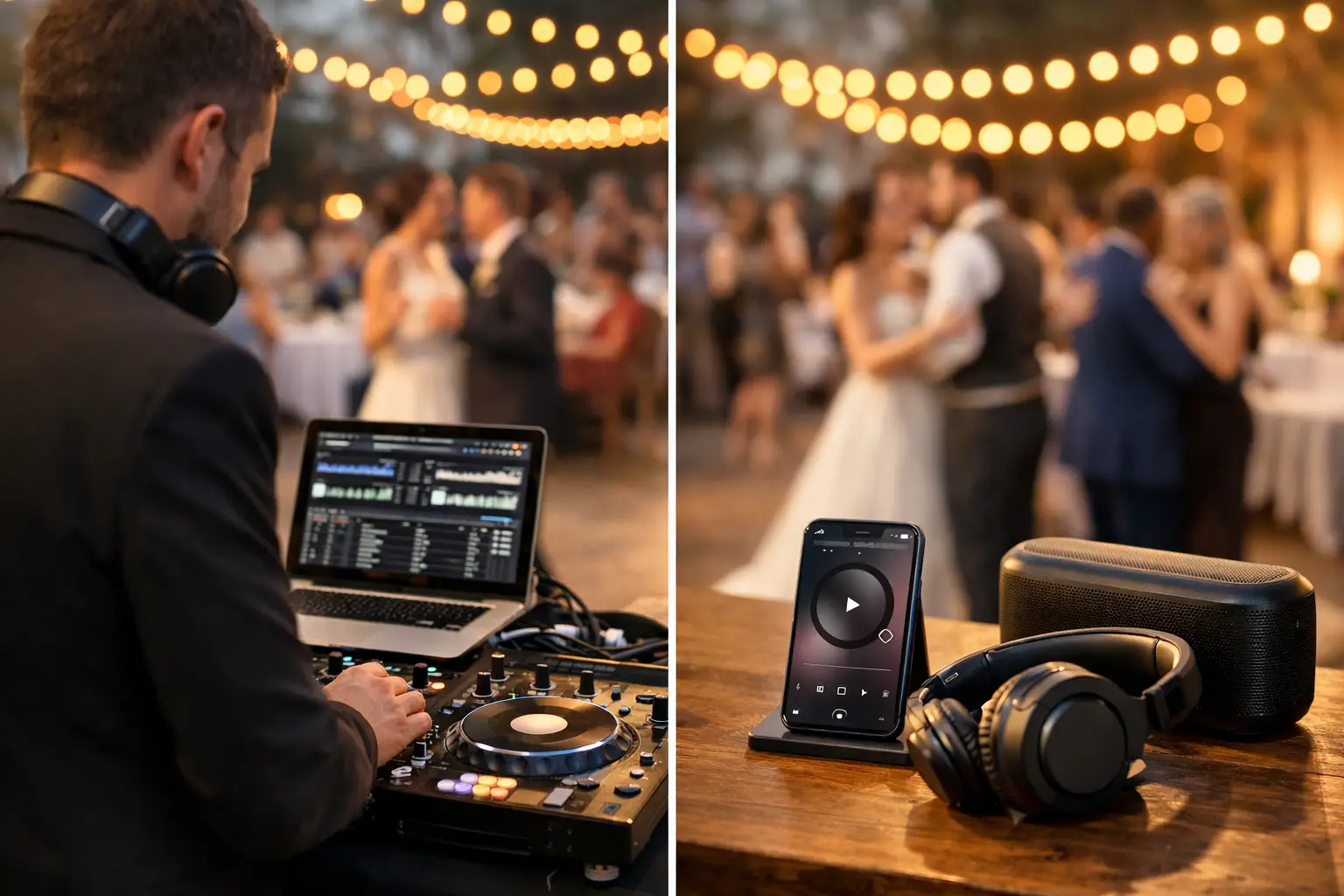
The moment the meal ends is where a wedding reception either gathers pace or quietly loses it. Couples weighing up a DJ versus playlist wedding reception are rarely just choosing how music is played. They are deciding who will read the room, manage the transitions, handle the unexpected and keep guests of different ages together on the dancefloor.
A carefully built playlist can be personal, cost-effective and absolutely right for a relaxed celebration. A professional DJ brings live judgement, quality sound and someone accountable for the evening’s flow. Neither option is automatically best. The right choice depends on your venue, guest list, budget and the kind of atmosphere you want to create.
DJ versus playlist wedding reception: the real difference
The main distinction is not simply a person with decks versus a phone with speakers. It is active event management versus a pre-set music plan.
A playlist plays the songs you have selected in the order you have selected them, with perhaps a little shuffle thrown in. That can work brilliantly while guests arrive, during the wedding breakfast or for a smaller reception where background music matters more than a full dancefloor. It gives you complete control over musical taste and lets you include the songs that mean something to you as a couple.
A DJ works with the same personal brief, but responds to what is happening in the room. If the first few tracks pull people onto the floor, they can build on that energy. If guests are enjoying Motown rather than modern pop, or singalongs rather than club classics, the set can change direction there and then. A good DJ does not simply play their own favourites. They understand the room, protect the couple’s preferences and make informed choices in real time.
That flexibility matters at weddings because no two guest lists behave in the same way. A track that looks perfect on paper may empty the floor after 45 seconds. Another, perhaps one you had not considered, can bring grandparents, friends and work colleagues together for three minutes of genuine celebration.
What a playlist does well
A playlist is not a lesser choice by default. It can be a thoughtful fit for couples who want a low-key evening, have a very clear musical identity or are hosting a reception where conversation is the priority. With time and care, it can also provide excellent music across the day without the expense of a DJ for every hour.
The strongest playlist-led receptions tend to be simple in technical terms. The venue has a suitable sound system, staff know how it operates, the room is modest in size and there is no expectation that someone will make announcements, coordinate formal moments or keep a packed dancefloor moving until late.
For it to work properly, prepare more than one queue. Have separate music for guest arrival, the meal, the first dance and the party. Download the tracks rather than relying on venue Wi-Fi, turn off notifications, assign one reliable person to operate the device and ensure they are not also part of the wedding party trying to enjoy the evening. Even a very good playlist needs an owner.
The technical side deserves attention too. A consumer Bluetooth speaker may be fine for a garden gathering, but it is rarely adequate for a function suite full of guests. Music can sound thin, vocals can become harsh and volume may not reach the back of the room evenly. A proper PA system, positioned and set correctly, makes a noticeable difference without needing to feel excessively loud.
Where playlists can become a risk
The risk with a playlist is not that it will sound bad. The risk is that it cannot make decisions when the event changes.
Wedding timings routinely move. The meal may overrun, photographs may take longer than planned, evening guests may arrive early, or a speech may need to happen before the first dance. Someone needs to fade music, provide a microphone, make a clear announcement and restart the right mood afterwards. With a playlist, these tasks often land on a best man, venue team member or family friend who did not expect to become the evening’s technician.
There are smaller problems too: a device locks, a cable fails, an advert plays through a free account, the wrong version of a first-dance song starts, or a guest repeatedly changes the queue. None of these are disastrous in isolation, but they are avoidable distractions on a day you have spent months planning.
Sound restrictions are another consideration. Many venues have sound limiters, specific power arrangements or rules on where equipment can be placed. A professional DJ will normally plan around these requirements and manage levels throughout the evening. Simply turning a speaker up until it feels lively can trigger a limiter or create uncomfortable sound near the dancefloor while guests at the bar hear very little.
What you are paying for with a professional DJ
A professional wedding DJ is part entertainer, part sound engineer and part calm pair of hands. Their value is not measured only by the number of songs they own.
They arrive with maintained equipment appropriate to the room, including professional sound, lighting and backup options. They set up safely, test the system and present it neatly. They can provide microphones for speeches, make announcements when requested and coordinate closely with the venue, photographer and wedding coordinator around the key moments.
Most importantly, they carry responsibility. If the room needs a different musical direction, the DJ acts. If a microphone develops a fault, there is a spare solution. If the evening needs holding back while the couple are outside for photographs, the music is adapted rather than left running through a carefully planned peak.
That does not mean a DJ should take over. The best results come from a clear brief: your must-plays, your do-not-plays, genres you love, songs with personal significance and the type of party you want. Whether that is polished chart pop, disco, indie anthems, R&B, house or a broad all-ages set, a professional should shape the night around you rather than deliver a generic routine.
At The Grind Events Hire, that approach is supported by professional-grade sound and lighting from recognised production brands, as well as the planning and technical experience to keep the focus on the celebration rather than the equipment.
Cost: look beyond the headline figure
A playlist may look free because the music subscription is already in place. In practice, there can still be equipment hire, delivery, setup, cables, lighting, a microphone and the cost of asking someone to manage it. If the venue’s own system is available and suitable, the calculation is different. Always ask exactly what is included and who takes responsibility if something stops working.
A DJ costs more because the service includes preparation, travel, setup time, professional equipment, insurance, experience and live delivery. For many couples, the question is whether that investment protects the part of the day where everyone is finally together and ready to celebrate.
There is also a useful middle ground. Some couples use a playlist for drinks and dining, then book a DJ for the evening party. Others hire a professionally specified sound system and lighting package, while appointing a confident friend to run music. This can work well, provided that person understands they have a role to fulfil and there is a proper technical plan behind it.
Choose according to your reception, not the trend
Choose a playlist if your reception is intentionally informal, your venue can support it properly and you are comfortable assigning someone to manage the music. It is especially suited to intimate gatherings where the soundtrack supports the occasion rather than drives it.
Choose a DJ if you want a lively dancefloor, have a broad mix of guests, need announcements or microphones, or would rather not ask friends and family to troubleshoot technology. A DJ is also the stronger option when the venue is large, acoustically challenging or requires a polished lighting and sound setup.
Before making the decision, ask your venue about sound limits, in-house equipment, setup access, finish times and any requirements for public-liability insurance or PAT-tested equipment. These practical details can determine what is realistic long before the first song plays.
Your reception does not need a prescribed format to be memorable. It needs music that feels like you, sound that guests can enjoy comfortably and a plan that leaves you free to be on the dancefloor instead of behind the playlist.