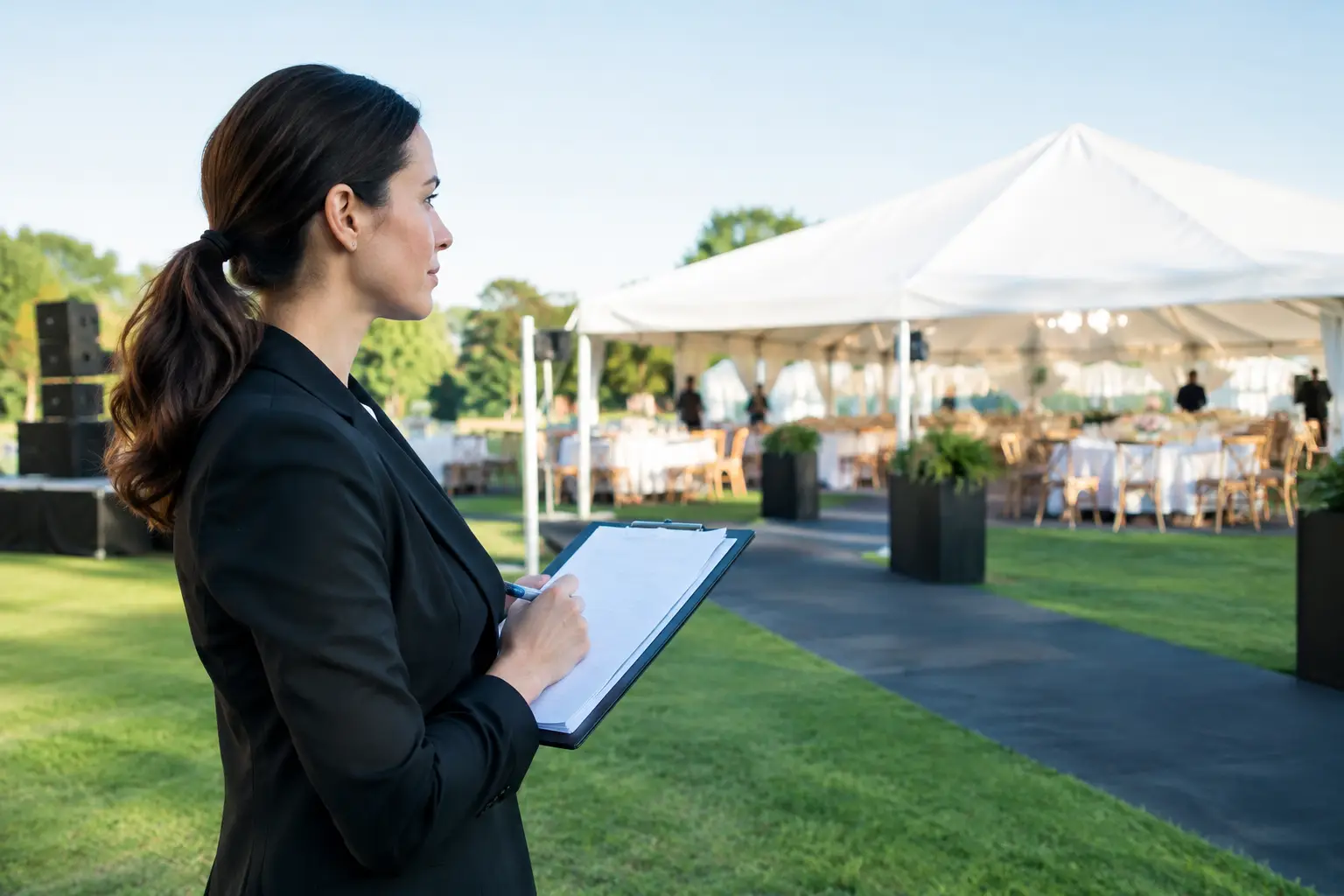
A great event should feel effortless to guests. That only happens when the practical details have been considered well before the first track plays or the first presentation begins. Event risk assessments are the working plan behind that confidence, helping organisers identify what could go wrong, who could be affected and what sensible controls will keep the occasion safe and on schedule.
For a wedding reception, school production, charity fundraiser or corporate launch, the risks will be different. The aim is not to bury a straightforward event in paperwork. It is to make proportionate decisions that protect people, equipment, the venue and the experience you have worked hard to create.
What an event risk assessment should achieve
A useful risk assessment is specific to the event, venue and equipment being used. Copying a generic document may tick a box, but it will not address a low ceiling above a lighting position, a busy fire exit beside the dancefloor or cable runs crossing a public area.
Start by considering the full event journey: load-in, set-up, soundcheck, guest arrival, the live event, pack-down and collection. A hazard can arise at any of those stages. For example, a room may be perfectly safe once a PA system is installed, but moving loudspeakers through a crowded corridor at the end of the night needs a separate plan.
The assessment should establish three things: the hazard, the people who may be affected, and the measures used to reduce the risk. It should also name the person responsible for checking those measures are in place. This creates clarity when several suppliers, venue staff and organisers are involved.
Build event risk assessments around the actual production
The best starting point is a conversation with the venue and each key supplier. Confirm the room layout, access route, ceiling height, available power, guest numbers, performance areas, timings and any site rules. Outdoor events also need a realistic weather plan, not just a hopeful forecast.
Power, sound and cable management
Electrical distribution is a common area where professional preparation matters. Equipment should be suitable for the job, professionally maintained and PAT tested where applicable. Avoid overloading sockets, unsuitable extension leads and improvised connections. A competent technician should understand the expected electrical load and use appropriate distribution rather than relying on a chain of domestic adaptors.
Cables need careful routing. Where they cannot be kept entirely away from guest routes, use suitable cable ramps or covers, secure them properly and make sure their location does not obstruct accessible routes, fire exits or doorways. Tape alone is rarely the right answer for a busy public walkway.
Sound levels deserve consideration too. A premium sound system can deliver clear speech and full music coverage without simply making the room uncomfortably loud. The right approach depends on the venue, audience, local restrictions and event format. A daytime awards presentation with wireless microphones has different needs from an evening party with a DJ and dancefloor.
Lighting, rigging and special effects
Lighting creates atmosphere, focus and a professional finish, but it must be installed with the same care as any other technical system. Fixtures need stable, suitable stands or approved rigging points, with safety bonds used where required. Stands should be positioned so guests cannot collide with them, and the footprint must be considered in narrow rooms or around seating plans.
Do not assume every decorative beam or ceiling point can take a lighting load. Venue approval and, where needed, competent rigging advice are essential. If there is any doubt, ground-supported lighting may be the safer and more practical choice.
Special effects require their own checks. Haze can affect fire detection systems, while confetti, cold spark effects and dry ice may have venue restrictions or require controlled operating areas. Confirm permissions early and make sure the operator understands the manufacturer guidance, exclusion distances and emergency arrangements.
Guest movement, capacity and accessibility
A well-designed room protects both safety and atmosphere. Keep fire exits, escape routes, signage and emergency equipment clear at all times. Do not let a backdrop, photo booth, speaker stack or gift table gradually migrate into an exit route as the room is dressed.
Consider how guests will move between the entrance, bar, toilets, seating, dancefloor and smoking area. This is particularly important when guests include children, older relatives, wheelchair users or people with limited mobility. Clear routes, sensible furniture spacing and good lighting reduce trip risks while making the event more welcoming.
Capacity is another practical limit. A venue may hold a certain number of guests for a seated meal but have a different safe capacity once a stage, dancefloor, production control position or large display is added. Ask the venue for its limits and plan the layout around them rather than trying to fit one more table into an already tight room.
Use a proportionate control plan
Not every hazard carries the same likelihood or consequence. A loose cable beside a busy entrance needs urgent attention. A spare microphone stored in a flight case at the side of a stage may simply need to be kept tidy and supervised. Risk assessment is about applying effort where it makes the biggest difference.
For most events, the final control plan should cover at least these distinct areas:
- safe access for delivery, loading and unloading;
- electrical safety, cable routing and equipment condition;
- fire exits, emergency procedures and venue communication;
- safe placement of sound, lighting, screens and special effects;
- crowd movement, capacity, accessibility and supervision.
Add controls that are genuinely deliverable. Writing that a technician will monitor a cable route throughout a six-hour event is only useful if a technician will actually be present and able to do it. In some cases, the better control is to reroute the cable or use a proper ramp so continuous monitoring is unnecessary.
Assign responsibilities before the day
Risk controls can fail when everyone assumes someone else is handling them. The organiser may be responsible for guest numbers and event timings, the venue for building systems and emergency procedures, and the production supplier for the technical installation and operation. Those boundaries should be clear before arrival.
Brief the people who need to know. A venue manager should understand where control positions, lighting stands and cable routes will be located. DJs, presenters and performers should know the stage limits and any equipment that must not be moved. If volunteers are supporting a fundraiser or school event, give them simple instructions on reporting spills, blocked exits or crowding.
For larger productions, keep relevant documents available on site, including insurance information, equipment records, method statements where appropriate and emergency contacts. The Grind Events Hire carries £10 million public-liability cover and supplies professionally maintained equipment, but good event safety still depends on a joined-up plan with the venue and organiser.
Review the plan when circumstances change
A risk assessment is not a document to file away once the doors open. Reassess if the weather changes, the room layout is altered, guest numbers rise, a performer brings additional equipment or a planned access route becomes unavailable.
A short pre-opening walk-through is one of the most valuable habits an organiser can adopt. Check exits, cables, equipment positions, trip hazards, lighting levels and the route to toilets or external areas from a guest's perspective. It is easier to move a stand, secure a cable or relocate a table before the room fills up.
After the event, record anything that did not go to plan. Perhaps loading access was too tight, speech microphones needed more coverage or a cable route caused congestion near the bar. These notes make the next event safer, faster to set up and better for guests.
Careful event risk assessments do not make an occasion feel controlled or corporate. Done properly, they create the freedom for guests to relax, performers to perform and organisers to enjoy the event they planned.