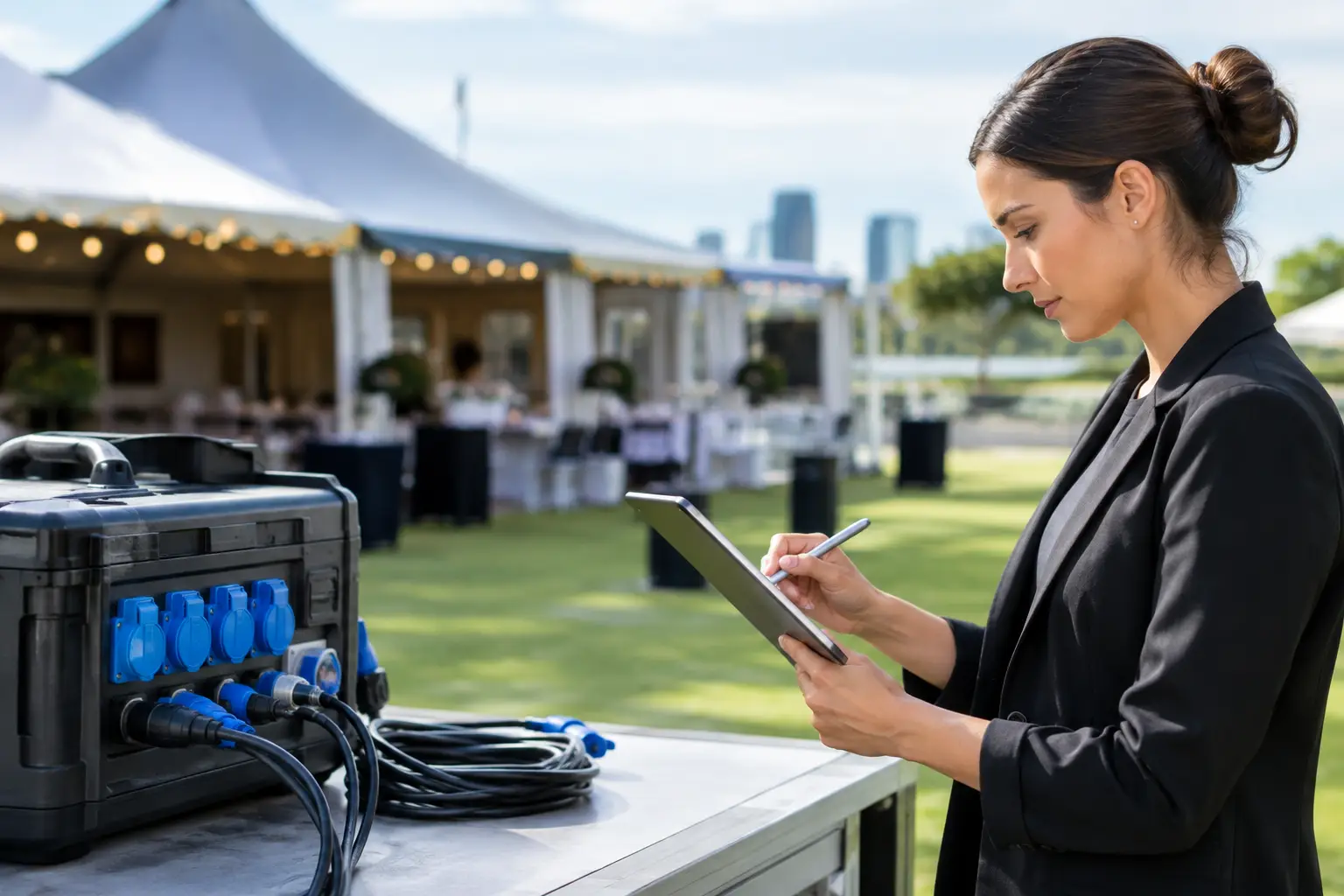
A great event can be let down by something nobody sees: a single overloaded socket, a poorly positioned cable run or a generator that cannot cope with the evening peak. This guide to event power planning is designed to help organisers make confident decisions before equipment arrives, protecting the guest experience as well as the production itself.
Power is not simply a venue question. It affects sound quality, lighting performance, catering operations, safety, set-up time and the options available for an outdoor site. Whether you are planning a wedding reception in a converted barn, a school production, a corporate awards evening or a charity event on a field, the best approach is to assess the real requirement early and build a practical plan around it.
Start with the event, not the nearest socket
The first question is not, "How many plug sockets are available?" It is, "What must be powered, where, and at what time?" A modest background-music system and a handful of uplighters may work comfortably from a suitable domestic-style supply. A DJ performance with a professional PA, moving lights, projection, catering equipment and a bar is a different proposition altogether.
Create a schedule of every electrical item expected on site, including equipment supplied by other contractors. This should cover audio, lighting, video, staging accessories, catering, refrigeration, heaters, inflatable attractions, exhibitors, charging stations and any temporary welfare facilities. Do not overlook seemingly small additions. A popcorn machine, coffee unit, hot-water boiler or patio heater can draw more power than several pieces of professional AV equipment combined.
It also matters when each item will run. A lighting rig may be on throughout the evening, while a caterer’s ovens and urns can create a significant peak during service. The power demand at 4pm during set-up may look very different from the demand at 9pm when the dance floor, bar, kitchen and outdoor areas are all active.
Understand watts, amps and available capacity
Most event equipment is rated in watts, while venue supplies are often described in amps. As a straightforward guide, watts divided by voltage gives amps. In the UK, a 2,300-watt appliance on a 230-volt supply draws roughly 10 amps. That is why a standard 13-amp socket should never be treated as an unlimited power source.
The figures on equipment labels are a starting point, but they are not the full story. Some devices draw a higher load on start-up, and equipment connected to the same circuit shares its capacity even when it is plugged into different wall sockets. A room with six sockets may still have all six supplied by one circuit breaker.
For professional events, a competent production supplier will assess the proposed load and allow sensible headroom. Running any supply close to its maximum for extended periods leaves little room for changes, start-up loads or the unexpected. It also increases the risk of tripped protection and avoidable disruption.
Check the venue supply before confirming production
Ask the venue manager for clear information about their electrical installation. Useful details include the location of distribution boards, the rating of available circuits, whether dedicated outlets are available for production, and what else shares those circuits. If the site has a history of tripping during events, that is valuable information rather than a minor inconvenience.
A site visit is often the most efficient way to resolve uncertainty. It allows the technical team to inspect outlet positions, assess cable routes, identify access restrictions and spot potential conflicts with catering, guest circulation or fire exits. It is far easier to adjust a production layout during planning than on the day, when tables are dressed and suppliers are working to a tight schedule.
Heritage venues, village halls, barns and temporary spaces deserve particular attention. Their infrastructure may be perfectly suitable for the event, but it may not have been designed for modern production, commercial catering and high guest numbers running together. Conversely, a newer venue may have substantial capacity but specific rules about which outlets can be used or who is permitted to access the electrical intake.
Separate critical systems where possible
Sound, lighting and video equipment benefit from clean, correctly distributed power. Where the scale of the event allows, separate circuits for production and catering reduce the chance that a kettle, oven or refrigeration unit affects the show. Dedicated power for a PA system is especially worthwhile where speeches, presentations or live performance are central to the event.
This is not about making a simple event unnecessarily complicated. It is about putting power where it delivers the most protection. At a wedding, the key priority may be keeping the ceremony microphone and evening entertainment stable. At a conference, it may be presentation screens, wireless microphones and the control position. At a public outdoor event, welfare, emergency access and trader requirements may take precedence alongside the main stage.
Guide to event power planning for outdoor events
Outdoor events need a different level of preparation because there may be no suitable mains supply at all. A generator can provide dependable power when specified, installed and managed correctly, but it is not just a larger plug socket on wheels.
Generator sizing should account for the calculated load, expected peaks and reserve capacity. A unit that is too small can struggle or trip when demand rises. One that is dramatically oversized may operate inefficiently at a very light load. The right answer depends on the equipment mix, the duration of the event, whether the load changes sharply during the day and whether critical services need an independent backup.
Positioning is equally important. Generators need safe access for delivery, refuelling and collection, while noise, fumes and sightlines must be considered for guests, neighbours and performers. Cable runs should be planned from the generator to each distribution point, not improvised after arrival. If a cable must cross a pedestrian or vehicle route, suitable cable protection and a safe route are essential.
Weather changes the conversation too. Connectors, distribution and equipment must be appropriate for external use and protected from rain, mud and accidental damage. A wet field can affect vehicle access, cable routing and the ability to position a generator safely. Build contingency into the site plan rather than hoping the forecast remains favourable.
Treat distribution and cabling as part of the production
Professional temporary power distribution does more than provide extra outlets. It allocates power safely, provides suitable protection and puts usable connections where departments actually need them. This is particularly valuable when the event includes a stage, separate bar area, outdoor reception space or multiple rooms.
Cables should be routed neatly and with purpose. The shortest route is not always the safest route if it cuts across an entrance, dance floor, fire exit or service corridor. In public areas, cables need appropriate covers or a different route entirely. Tape alone is not a universal solution, especially where heavy footfall, wheelchairs, trolleys or vehicles are involved.
Avoid daisy-chaining extension leads or relying on household multiway adaptors to build an event system. It can create overloaded connections, loose joints and difficult fault-finding. Use professionally maintained, PAT-tested equipment and make sure the people responsible for set-up understand the load they are connecting.
For larger events, the electrical installation and temporary distribution may require a qualified electrician or specialist temporary-power provider. The production team should coordinate closely with them, particularly where generator supplies, three-phase power, temporary structures or public access are involved. Safety and compliance are shared responsibilities, not an afterthought for the final hour of set-up.
Plan for the moments that matter most
A reliable power plan has a sensible response to failure. That does not mean every private party needs duplicate generators and full redundant distribution. It means identifying what cannot be allowed to stop and choosing proportionate protection.
For a small indoor celebration, that may mean keeping the DJ and PA on a known, dedicated circuit rather than sharing with catering. For a corporate event, it may mean a backup presentation laptop, spare microphone batteries and an alternative route for essential power. For a festival-style event, it may mean separate generator capacity for critical systems, fuel planning and an on-site technician who can respond quickly.
Communication is central to this. Make one person responsible for approving changes to the power plan. If a supplier arrives with additional equipment, it should not simply be plugged into the nearest available outlet. A late addition can alter the load calculation, block a cable route or compromise a circuit intended for something more critical.
The most successful events make technical planning feel invisible to guests. With the right assessment, professionally maintained equipment and an experienced team, power supports every key moment without becoming one. The Grind Events Hire can help organisers turn a venue’s electrical limitations into a clear, workable production plan - leaving you free to focus on the people in the room and the occasion they came to celebrate.