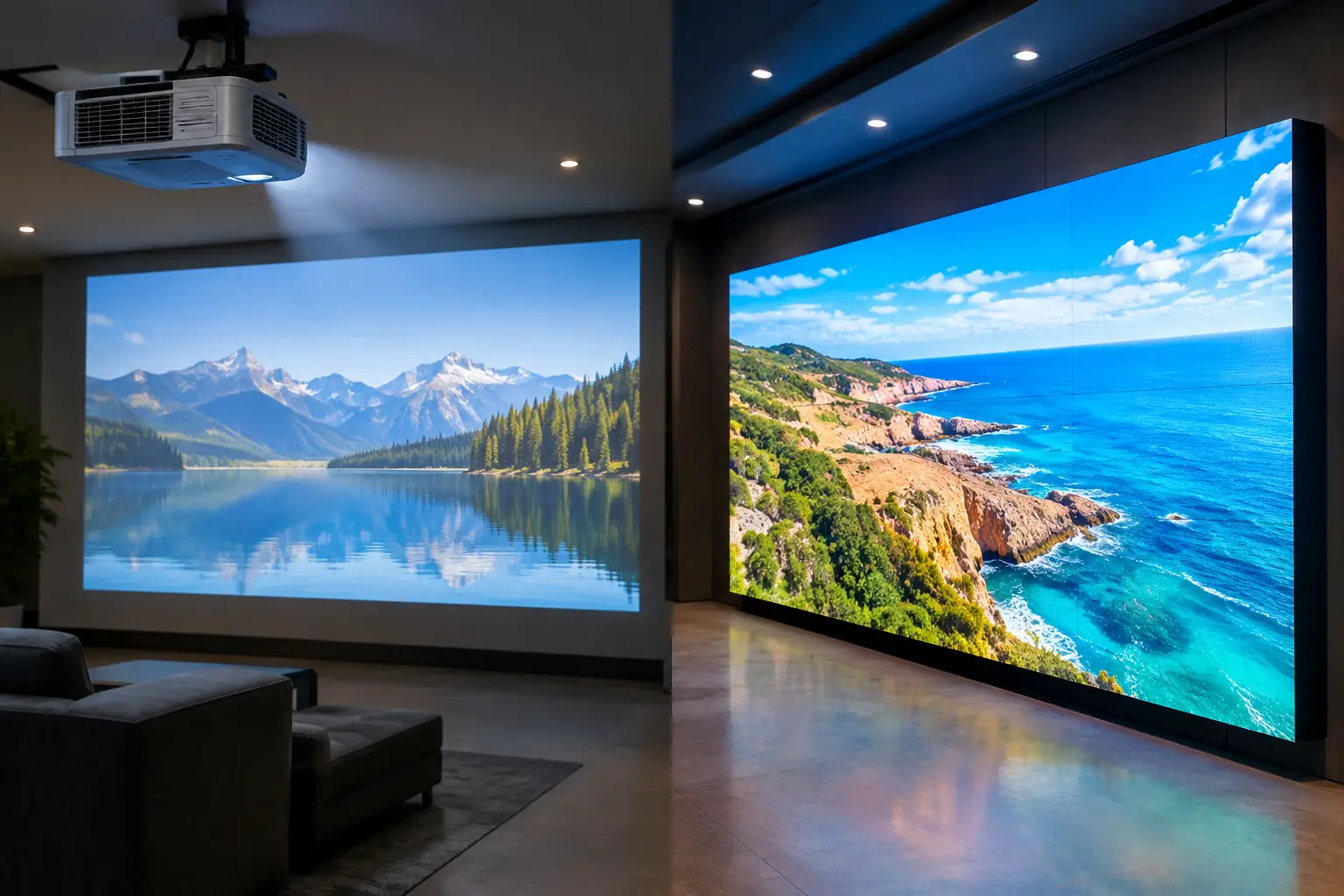
A presentation can be perfectly prepared and still lose the room if the screen is washed out, too small or positioned badly. When weighing up HD projection versus LED walls, the right choice is rarely about choosing the newest technology. It is about matching the display to the venue, audience, lighting conditions and purpose of the event.
For a wedding slideshow, a school awards evening and a high-impact product launch, the answer may be different every time. Both options can look exceptional when specified and installed properly. The costly mistakes happen when a screen is selected from a photo or a price list rather than a proper event brief.
HD projection versus LED walls: the essential difference
HD projection creates an image by throwing light from a projector onto a screen or suitable projection surface. It remains one of the most adaptable ways to create a large-format display, particularly in darker rooms, theatres, function suites and venues where a discreet screen is preferred.
An LED wall is built from modular LED panels that produce their own light. There is no projector beam, no need for a projection screen and far greater resistance to ambient light. It can deliver a bright, vivid image in challenging conditions, from a daylight-filled conference venue to an outdoor stage.
That distinction affects almost every practical decision: image brightness, space requirements, viewing distance, budget, rigging, power and the type of content that will be shown.
When HD projection is the stronger choice
Projection is often the most elegant and cost-effective option for events held in controlled lighting. A high-quality HD or 4K projector paired with the correct screen can create a large, cinematic image without turning the display into the focal point of the room before the programme begins.
This makes it particularly well suited to wedding breakfast rooms, gala dinners, school productions, conferences and charity events. If guests are watching a film, a photo montage, sponsor slides or a speaker presentation in a dimmed space, projection can offer excellent scale and detail for a sensible investment.
Projection also gives flexibility in screen size and format. A standard widescreen display works well for presentations and video, while a rear-projection arrangement can keep equipment and cables out of sight where venue access allows. For stage shows, projecting scenic backdrops can be more practical than constructing large physical set pieces.
There are, however, conditions that projection cannot overcome. Bright windows, house lights aimed at the screen, decorative uplighting and direct sunlight reduce contrast quickly. A projector may be powerful, but it is still fighting against other light in the room. Black areas of an image become grey, colours lose impact and smaller text becomes difficult to read.
The projector’s position matters too. It needs a clear line of sight to the screen, sufficient throw distance and careful alignment. A low-mounted unit can be interrupted by people moving through the room, while a ceiling or truss position may require a suitable rigging point and safe cable routes. These are details best resolved during planning, not as guests arrive.
Projection works best when the room can work with it
A darker venue does not have to be completely blacked out. It does need manageable ambient light and a screen placed away from strong windows or competing lighting. For daytime events, blackout curtains, screen placement and controlled lighting can make a major difference.
Content should also be prepared for projection. Large, high-contrast text, clean graphics and properly sized video files are more reliable than pale fonts, detailed spreadsheets or low-resolution images stretched to fill a large screen. A professional setup can improve the presentation, but it cannot invent detail that is not in the source material.
Where LED walls earn their place
LED walls are designed for impact. Because each panel emits light, the image remains bright and legible in spaces where projection would struggle. This is their biggest advantage for corporate launches, branded events, sports presentations, festivals, exhibition stands and outdoor occasions.
They also perform well where the display must compete with a lively environment. A conference room with daylight, a stage surrounded by intelligent lighting or a venue where the house lights cannot be dimmed may all point towards LED. Video, brand colours and motion graphics retain much more of their intended punch.
An LED wall is not limited to a conventional screen shape. Modular panels can be built to suit a stage width, a portrait display, a square format or a wide backdrop. That gives event designers more creative freedom, especially when content is built specifically for the display.
For audiences close to the screen, pixel pitch is critical. Pixel pitch is the distance between the LEDs on the panel, measured in millimetres. A smaller number generally means a sharper image at close range. A fine-pitch wall is appropriate for an indoor presentation where delegates may be standing only a few metres away; a larger-pitch product can be ideal for an outdoor audience viewing from further back.
Choosing pixel pitch solely by price can lead to disappointment. A wall that looks excellent from ten metres may appear visibly pixelated from two metres. Equally, paying for an ultra-fine pitch screen for a distant audience is unnecessary. Viewing distance should drive the specification.
LED is brighter, but it is not automatically better
LED walls need more than panels. They require a processor, properly distributed power, data cabling, secure support or rigging, signal management and experienced installation. Depending on the scale, this can involve a ground-support system, stage deck, truss or a purpose-built frame.
The physical depth of the wall should be considered as well. In a compact function room, a screen that sits forward of the stage can reduce usable space. Fan noise from supporting equipment, load-in access, power availability and sightlines for people seated at the sides all deserve attention.
LED is typically a larger investment than projection, particularly for fine-pitch indoor panels. It is often the right investment when visibility, brand presence and lighting conditions demand it. For a dimmed dinner presentation, it may be more display technology than the event needs.
Comparing the real-world trade-offs
The most useful question is not, “Which one has the better picture?” It is, “What must guests be able to see, from where, and in what conditions?”
For controlled indoor environments, projection usually provides impressive scale and a softer, more cinematic feel. It can be less visually intrusive before the content starts and may leave more budget available for sound, lighting, staging or entertainment.
For bright venues and high-energy visual production, LED offers confidence. The display stays visible with room lights on, copes far better with daylight and creates a polished focal point for branded content. It is particularly effective when the screen is part of the stage design rather than simply a presentation tool.
Resolution should not be judged by a single headline figure. An HD projector may produce a very detailed image across a large screen, but perceived quality depends on the screen size, audience distance, source content and lighting. With LED, the panel resolution and pixel pitch must be matched to the wall dimensions and viewing distance.
Reliability is also about the complete system. A professional projection package needs stable mounting, tested lenses, correctly sized screens and backup signal routes where the event is mission-critical. A professional LED installation needs properly configured panels, secure assembly, calibrated processing and power planned around the venue. In either case, insured, PAT-tested equipment and trained technical support reduce avoidable risk.
Content, cameras and live presentations
If the display will show a laptop presentation only, both technologies can work well. If you are adding live cameras, video playback, walk-on stings, branded holding slides or multiple content sources, the signal plan becomes more important.
LED walls are particularly effective for live camera relay because they retain brightness under stage lighting and make speakers easier to see from the back of a large room. Yet a projected image can still be an excellent choice for a conference or awards ceremony where the lighting is controlled and the display is large enough for the audience.
Ask early whether presentations will arrive on the day, whether content is 16:9, whether videos include sound and whether a remote speaker needs to be brought into the room. Last-minute file conversions and unfamiliar laptop outputs are common event problems. A production team can plan adapters, playback, audio routing and test time so the screen supports the event rather than delaying it.
Start with the event, not the screen
A venue visit or detailed technical conversation often makes the decision straightforward. Consider the room’s daylight, ceiling height, stage position, audience size, nearest viewing point, access route, available power and whether the display must support brand impact or simply clear communication.
The Grind Events Hire plans display systems as part of the wider production, considering sound, lighting, staging and audience sightlines together. That approach prevents a bright screen being undermined by poor placement, or a well-designed presentation being lost in a room that cannot support projection.
If guests need to feel the scale of a launch, see live content in a bright venue or engage with bold visual branding, an LED wall may be the right centrepiece. If the aim is a refined large-screen experience in a controlled room, HD projection can be every bit as effective. Give the display a clear job to do, and let the venue and audience decide the technology.