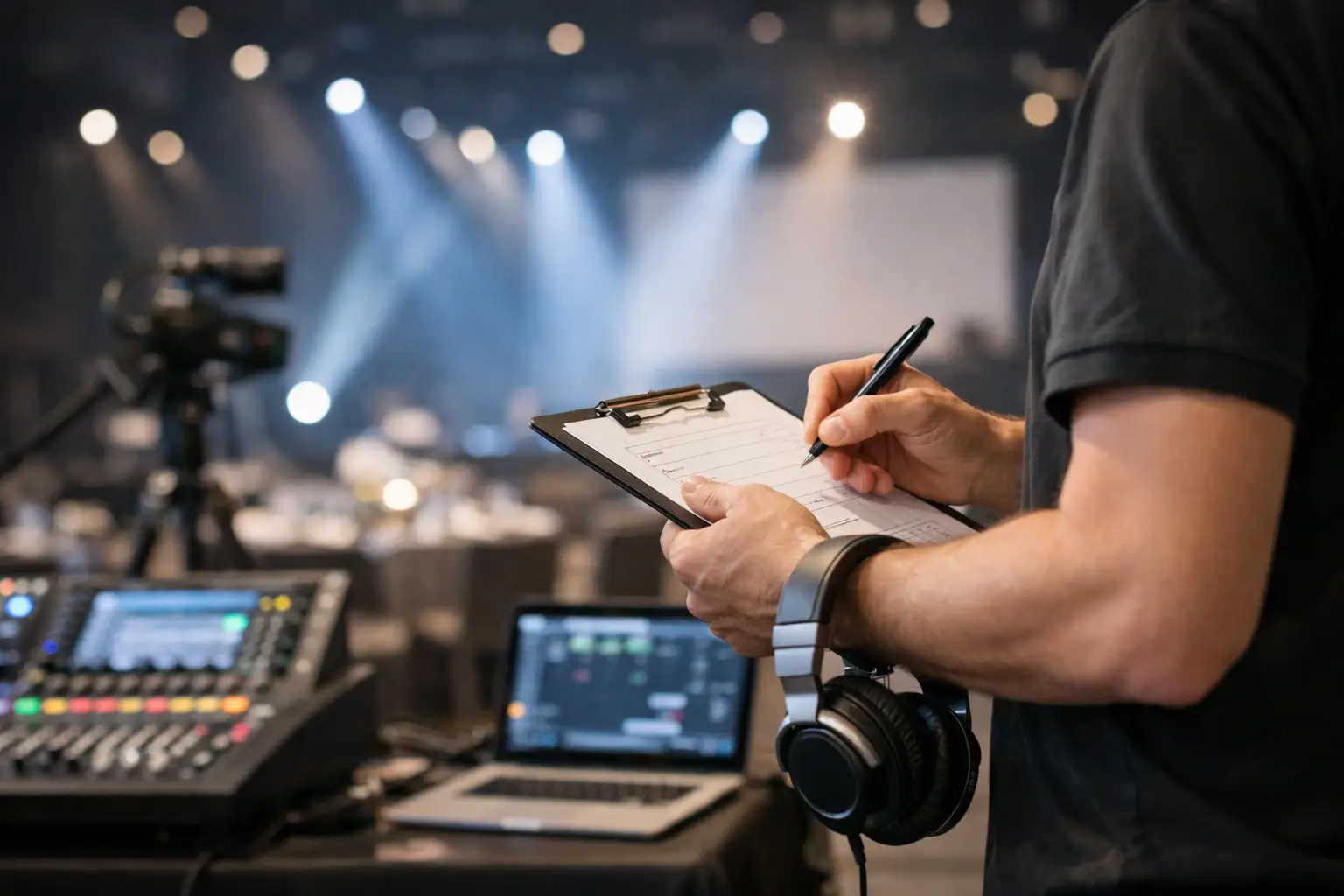
A beautiful room can still disappoint if guests cannot hear the speeches, the lighting is too harsh for photographs, or the power trips halfway through the evening. A proper venue event technical checklist turns those avoidable problems into planned decisions, giving organisers, venue teams and suppliers a shared picture of what the event needs to work well.
For a small birthday party, the technical plan may be straightforward. For a wedding breakfast that becomes an evening reception, a school production, awards night or branded launch, there are more moving parts. The principle remains the same: assess the room early, agree responsibilities clearly and allow enough time to build, test and operate the system properly.
Start With the Event, Not the Equipment
It is tempting to begin with a speaker package or lighting rig. Start instead with the guest experience. How many people are attending? Where will they arrive, eat, watch, talk and dance? Will there be speeches, a DJ, live performers, video playback, presentations or remote contributors?
A system that is ideal for 80 guests in a compact function room will not necessarily cover 200 guests across a long banqueting suite. Equally, more equipment is not automatically better. Excessive volume makes conversation difficult, while over-lighting can make a wedding breakfast feel clinical. The right specification depends on the room, the programme and the atmosphere you want to create.
Ask the venue for a current floor plan, ceiling height, room dimensions and photographs taken during previous events. It is also useful to establish whether doors will remain open, whether there are hard reflective surfaces, and whether nearby rooms or residents could be affected by sound. These details influence speaker placement, lighting choices and achievable sound levels.
Venue Event Technical Checklist Before You Book
The planning stage is where most costly surprises can be prevented. Confirm the following with the venue before committing to suppliers or finalising the event timetable:
- Access and loading: Find out where vehicles can unload, whether there are steps, narrow corridors, lifts or long distances to the event space, and whether loading must happen within set hours.
- Power provision: Ask for the location, rating and condition of available sockets. Establish what else shares those circuits, particularly catering equipment, bars, heating and venue lighting.
- Sound restrictions: Check for a fitted sound limiter, decibel limits, curfews, restrictions on subwoofers and rules around live drums or amplified music.
- Rigging and room rules: Confirm whether lighting can be attached to anything, whether naked flames, haze, confetti or cold spark effects are allowed, and what protection is required for flooring and walls.
- Internet and display facilities: If streaming, video calls or presentations matter, test the actual connection and identify available screens, projectors, HDMI inputs and playback formats.
Do not rely on a verbal assumption that a venue is “fully equipped”. That can mean anything from a fixed projector to a single domestic extension lead. Request specifications where possible, including screen size, projector brightness, microphone type and the connection points available. A pre-event site visit is often the simplest way to confirm the facts.
Build a Realistic Production Schedule
Technical delivery needs time at both ends of the event. Setup is not simply carrying equipment into the room. Speakers must be positioned safely, cable routes protected, lighting focused, microphones checked, audio balanced and playback tested. The room may also need to be reset around caterers, decorators and furniture teams.
Allow extra time where there is limited access, a room turnaround, complex staging or a large lighting installation. For corporate events, schedule a full rehearsal for presenters where practical. A five-minute check before doors open is not enough to discover that a laptop does not recognise the display or that a guest speaker needs a different microphone.
Plan Sound for Every Moment
A reliable sound plan separates background music, spoken word and entertainment. Each has different requirements. Gentle music during a meal should sit comfortably beneath conversation. Speeches need clarity at every table. Evening entertainment needs controlled energy without becoming harsh or overwhelming.
For speeches and presentations, select microphones according to the format. A handheld wireless microphone is flexible for toasts, audience questions and multiple speakers. A lapel or headset microphone may suit a presenter who needs both hands free. Lecterns often work well with a discreet gooseneck microphone, but they must still be tested with the individual using them.
Think about who controls playback. A venue laptop, a guest’s mobile phone and a professional media playback system all introduce different risks. Provide files in advance, keep a back-up copy on a separate device and agree who has authority to make last-minute changes. If video content includes sound, test it through the PA rather than assuming it will play correctly.
Professional sound systems from established manufacturers are designed to deliver clarity and coverage, but operation matters as much as the kit. Correct positioning, sensible gain structure and an experienced technician make the difference between clear speech and unwanted feedback.
Make Lighting Work for the Room and the Camera
Lighting does more than make a room colourful. It directs attention, supports the schedule and changes the perceived quality of a space. Warm, controlled uplighting can give a plain venue character during a dinner. A focused stage wash allows speakers and performers to be seen. Dynamic dancefloor lighting can lift the atmosphere after formalities are complete.
Consider the room in phases. Daylight through windows may be welcome during an afternoon ceremony but can make projection difficult. House lights may be suitable for service but unflattering for photography. Discuss whether venue lighting can be dimmed in zones and who controls it during the event.
If a photographer or videographer is involved, coordinate early. They will appreciate enough front light for speeches and first dances, but may not want bright fixtures pointed directly into the camera position. Haze can add depth to beams in the evening, yet it may be prohibited by venue policy or trigger sensitive fire detection systems. It depends on the building and the desired look, so it should never be an automatic addition.
Treat Power, Cables and Safety as Production Priorities
Power is one of the least glamorous parts of event planning and one of the most important. Avoid daisy-chained extension leads, overloaded socket strips and cable routes across public walkways. Equipment should be professionally maintained, PAT-tested where applicable and connected through appropriate distribution.
Every cable crossing a guest route needs proper protection. Speaker stands, lighting stands and screens must be positioned so they cannot be knocked, obstruct exits or compromise the layout. This is particularly relevant where children, busy bar areas or crowded dancefloors are involved.
Your supplier should hold suitable public-liability insurance and be ready to provide risk assessment and method statement documentation when the venue requires it. For more complex productions, appoint a clear point of contact who can make decisions on site. If something changes - a delayed room handover, an additional table, a blocked access route - the technical team needs prompt information to adapt safely.
Prepare for What Might Change
Even well-planned events move. A speech may run late, a performer may arrive with an unexpected input requirement, or weather may force an outdoor reception indoors. Contingency is not pessimism. It is how professional events retain their polish when plans shift.
Keep essential spares available: batteries, chargers, adapters, playback cables, microphone options and back-up music. For larger events, consider a spare presentation laptop or at least a tested way to access files independently of the main device. If power is limited, identify in advance what can be reduced or switched off without affecting safety or the core guest experience.
It also helps to agree a simple communications plan. The event organiser, venue manager, caterer, photographer and technical lead do not need constant meetings, but they should know who is responsible for key cues such as doors opening, speeches, cake cutting, awards walk-ons and the first dance.
Leave Room for Professional Judgement
A checklist is not a substitute for experienced technical support. It gives everyone a reliable starting point, but every venue has its own quirks: a sound limiter that reacts unexpectedly, a loading route shared with the kitchen, poor sightlines from certain tables or a projector that performs differently in daylight.
The Grind Events Hire approaches these details as part of the event, not an afterthought. From professionally maintained sound and lighting equipment to practical on-site problem-solving, the goal is to make technical production feel calm and well managed for the organiser.
The strongest events rarely look “technical” to guests. They simply hear every word, see what matters, enjoy the atmosphere and leave remembering the occasion rather than the equipment behind it.